Head office or your landlord wants a waste management plan for your site, and you have nothing to start from. Keep it to one page per site. The page says what you throw away, where each stream goes, who takes it and what record you keep. Fill it in from a week's audit, then review it each quarter.
Some entries depend on the state your site is in. The template asks that first.
Fill in one page like this for each site
Copy these three tables for every site you run.
| Site details | Fill in |
|---|---|
| Site | ____ |
| Local council | ____ |
| In an Act 672 state? | Yes / No |
| Plan owner on site | ____ |
| Next review date | ____ |
| Stream | Bins (type × number, where) | Collector, and its licence | Pickups | Where it goes (ask the collector to name the site) | Record kept |
|---|---|---|---|---|---|
| General waste | ____ | ____ | ____ | ____ | Weight, photo, timestamp |
| Cardboard and paper | ____ | ____ | ____ | ____ | ____ |
| Plastics | ____ | ____ | ____ | ____ | ____ |
| Metals and cans | ____ | ____ | ____ | ____ | ____ |
| Food waste | ____ | ____ | ____ | ____ | ____ |
| Glass | ____ | ____ | ____ | ____ | ____ |
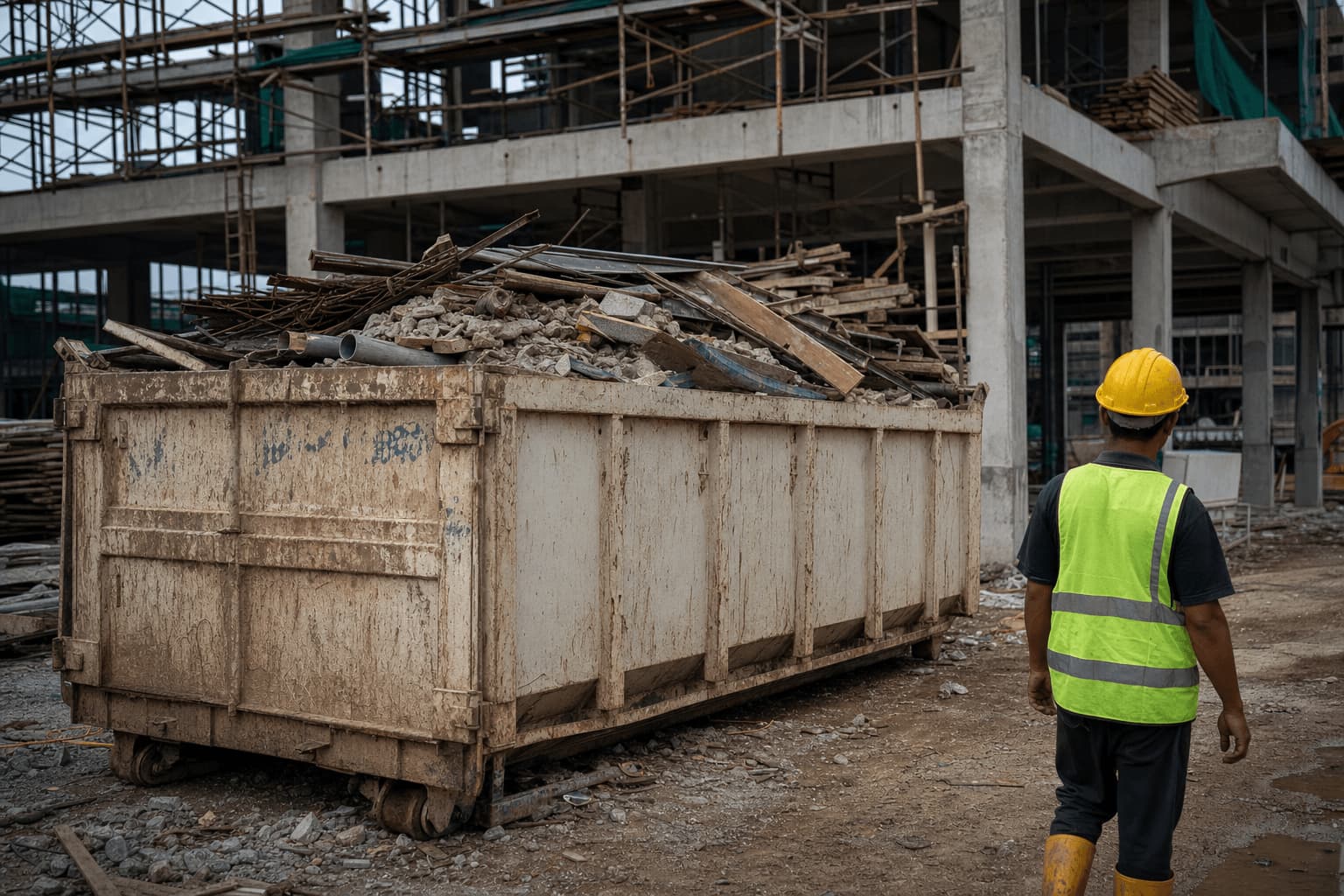
| Bulky or renovation waste | ____ | ____ | ____ | ____ | ____ |
| Scheduled waste (if any) | ____ | DOE-licensed contractor | ____ | ____ | Consignment note, kept at least three years |
| Baseline and target | Tonnes a month |
|---|---|
| Generated | ____ |
| Diverted | ____ |
| To disposal | ____ |
| Diversion rate | ____% |
| Target | ____% by ____ |
Each row is one stream. Delete a stream your site does not produce, and add one it does. A canteen adds food waste. A workshop with spent oil or old batteries adds scheduled waste.
Two columns do most of the work. "Where it goes" is a question for your collector, not a guess. Ask them to name the landfill or the recycler. "Record kept" is what you can show when someone asks. For a GarGeon pickup, that is a photo, a timestamp and the weight.
Keep the page short. The process behind it, from audit to first report, is our 90-day waste diversion programme. This page is the document that process fills in.
Start the plan from a weighed baseline, not a guess
A plan built on guesses sets targets nobody can check. So weigh first. A waste audit gives you the tonnes in each stream and where each one goes today.
Here is what a weighed baseline looks like. A retail mall client sent 111.51 tonnes to landfill in the second quarter of 2026 and recycled 5.33 tonnes. That is 4.6% recycled for the quarter. The rate fell each month, from 6.7% in April to 3.2% in June. The figures are published with the client's permission.
Baselines differ a lot. GarGeon's measured spread is 4.6% (a mall), 8% (a wholesaler) and 73.69% (an e-commerce warehouse). So do not copy another site's figure into your plan. Use your own.
Name the collector and its licence for every stream
The licence to write down depends on your state and on the waste.
- In an Act 672 state (Kuala Lumpur, Putrajaya, Johor, Kedah, Melaka, Negeri Sembilan, Pahang and Perlis), write down a collector licensed under the Act. The collector applies through SWCorp, SWCorp recommends, and the Director General of the National Solid Waste Management Department grants the licence. Ask for its SWCorp licence number and confirm it with SWCorp.
- In Selangor and the other states, check with your local council or state government. On 29 July 2026 the Housing and Local Government Minister announced that the Cabinet had agreed to extend Act 672 to Selangor in phases, covering all 12 local authorities. No start date or phase order has been published. So Selangor's local councils and KDEB Waste Management still run solid waste there today.
- Scheduled waste, in every state, goes to a contractor licensed by the Department of Environment. Check it on the eSWIS list at eswis.doe.gov.my. Keep the consignment note for each pickup for at least three years.
The licence protects you as well as the collector. Under section 71 of Act 672, causing or permitting waste to be handled outside the Act is an offence. It carries a fine of RM10,000 to RM100,000, or six months to five years in jail, or both.
Set targets from your own baseline
A target needs a formula you use every time. Use the diversion rate: diverted ÷ (diverted + directed to disposal) × 100. Our guide to waste management KPIs sets out that formula and four more.
For the mall above, that is 5.33 ÷ (5.33 + 111.51) = 4.6%.
Work in tonnes, not bins. The GRI waste standard asks for three figures: waste generated, waste diverted from disposal and waste directed to disposal, each as a total weight. It lists incineration with energy recovery under disposal. Your baseline table holds the same three figures, so a report can use them as they are.
Then set a target against your own baseline, with a date. We know of no sourced Malaysian benchmark to borrow. Start with the streams that weigh most and are clean enough to recover. Separation at source keeps them clean. Our zero-waste ladder shows where the targets lead after that.
Construction sites need a plan of their own for GBI
If a building project is going for GBI, the plan is part of the evidence. GBI's design reference guide for its new-construction tool (NRNC, version 2.0) covers the construction-waste credit, MR6. At completion it asks for the waste management plan, with "a verified record of truck loads of diverted, recycled or landfilled waste against total truck loads". Ask your facilitator which tool version applies. CIDB's Guidelines on Construction Waste Management, on CREAM's site, include a sample plan. Our construction waste guide covers the rest.
We write the plan with you after an audit
You do not have to fill the page in alone. We start with a waste audit, which takes about a week.
The plan is our five steps on paper. The audit fills in the baseline. Separating at source sets the bins. Routing names where each stream goes. Recovering shares the rebate on your recyclables with you, through Recycle Solutions. Proving fills the record column, with every pickup on GarGeon Connect. General waste still goes to landfill, with a record of every pickup.
One partner for every stream at every site is total waste management. We work through licensed collectors across KL, Selangor & Johor.