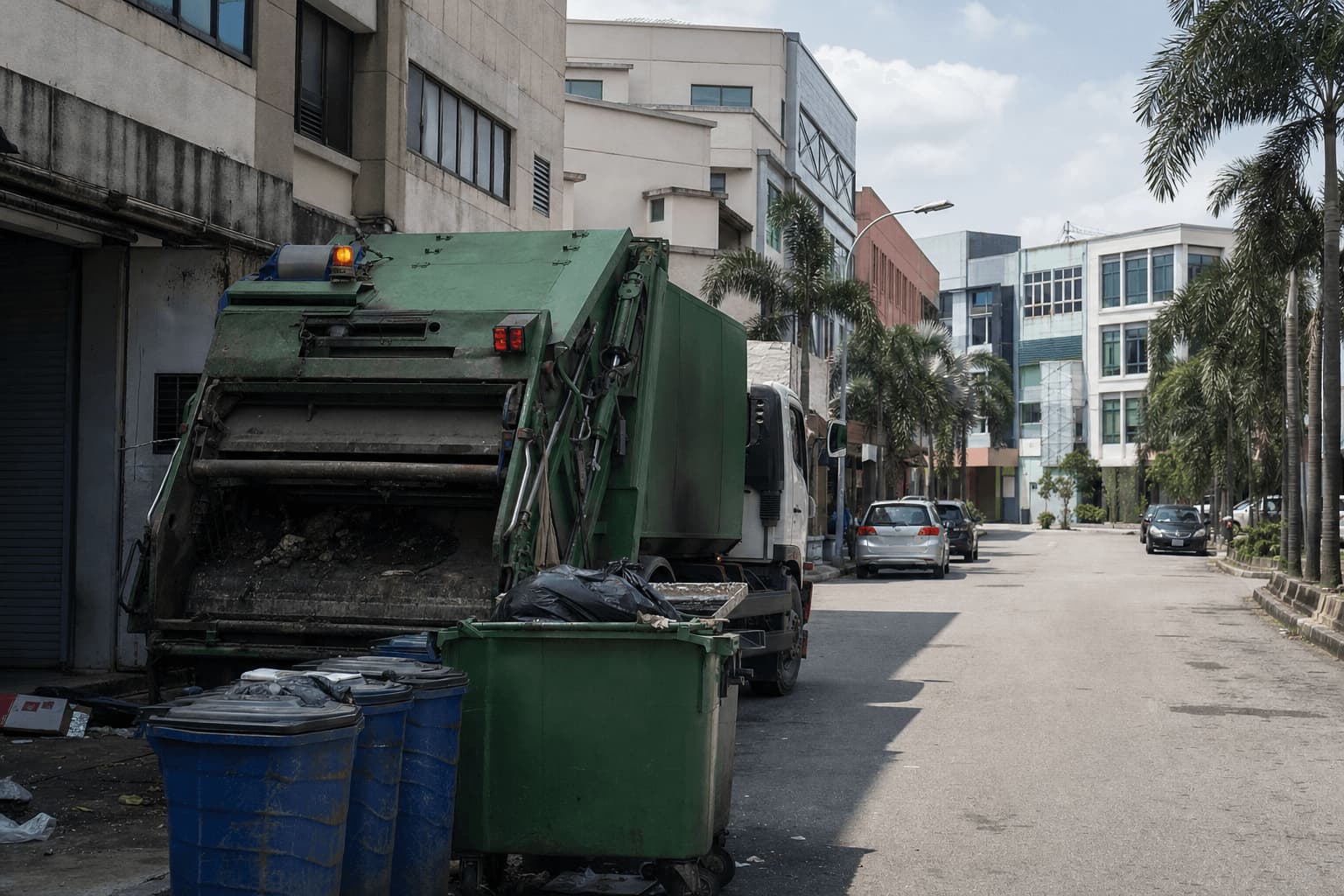
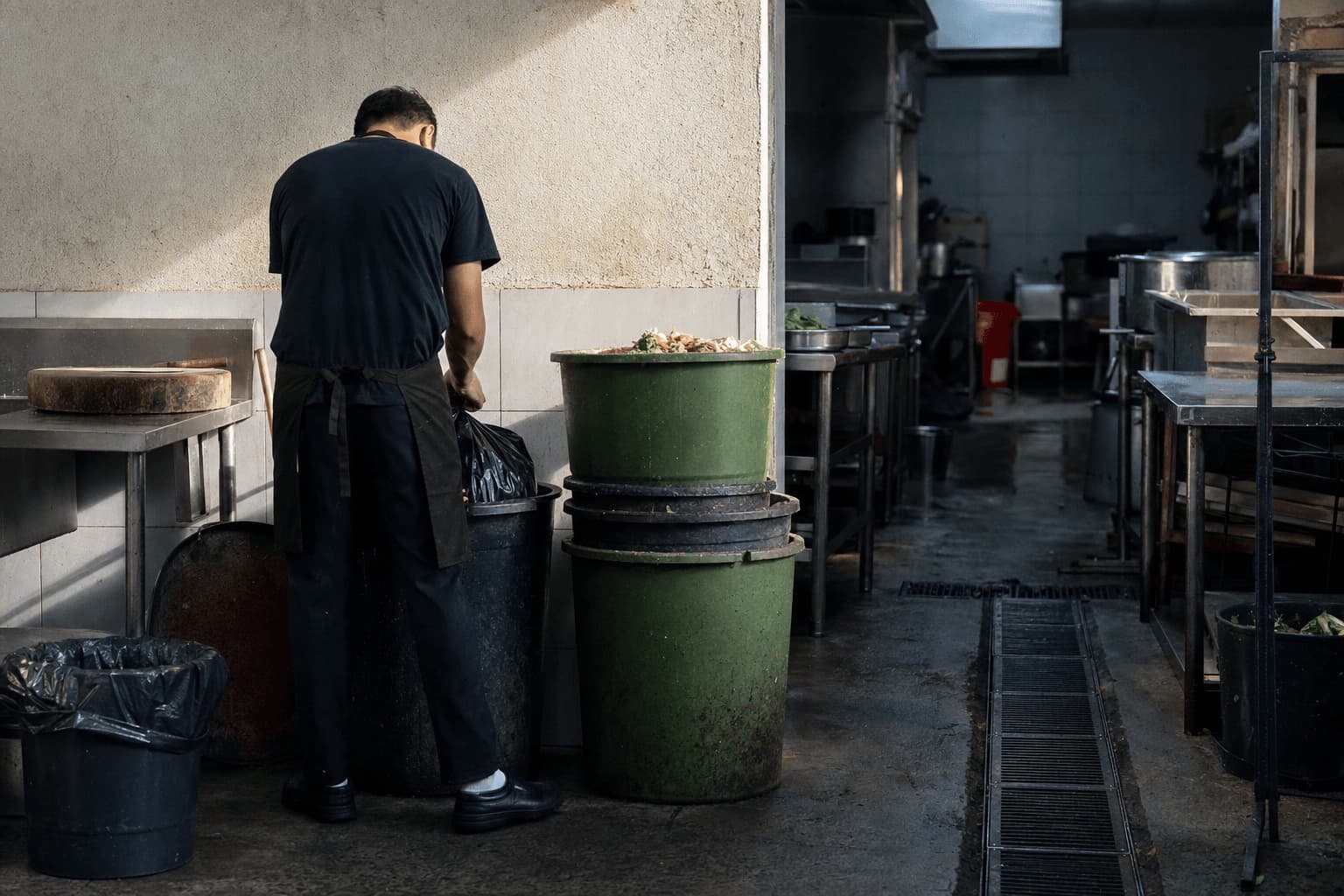
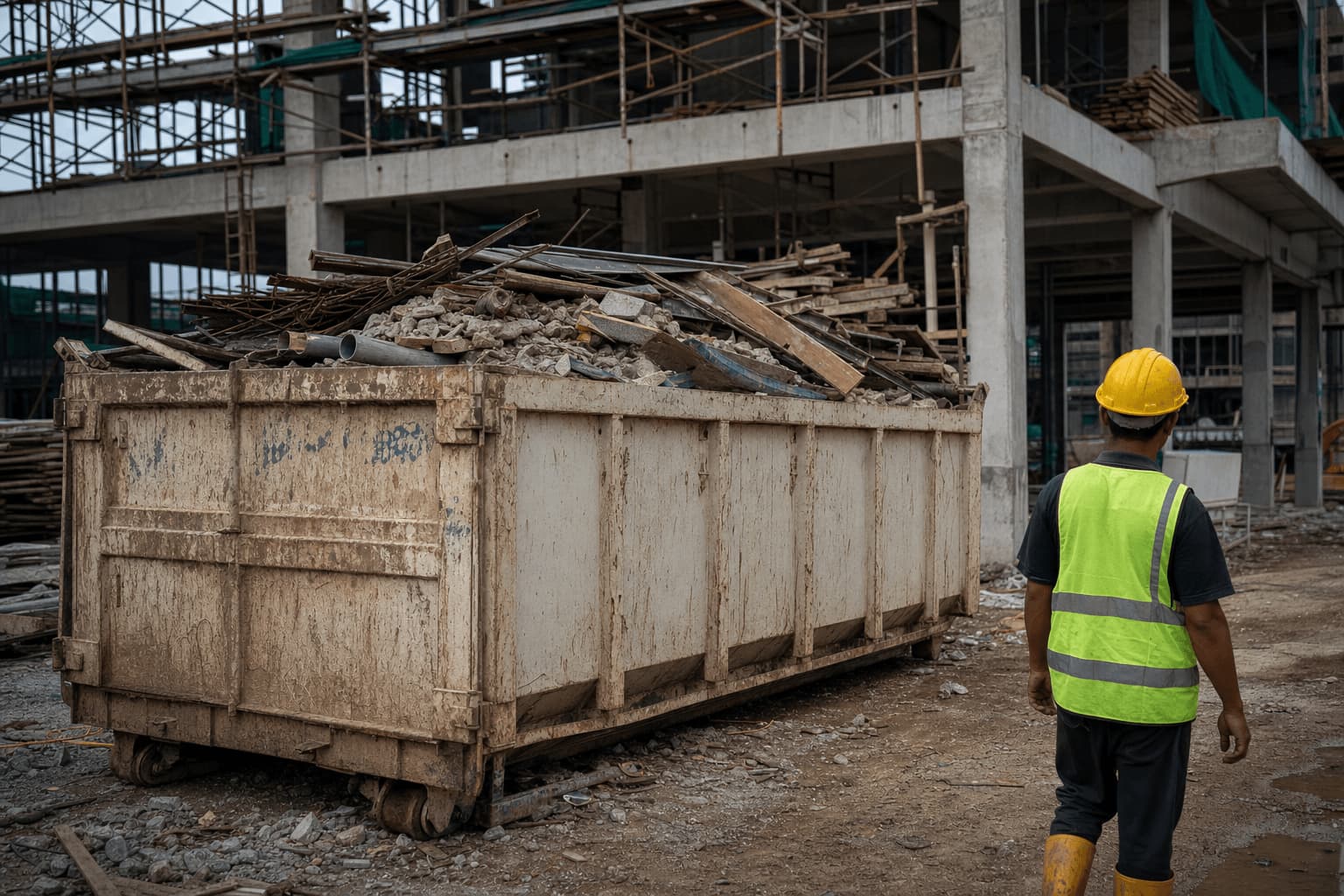
When a lorry leaves your site, your general waste goes to a landfill, and you pay for it by the tonne. At Jeram Sanitary Landfill in Kuala Selangor, our partner collectors are charged from RM95.50 a tonne, and we pass that on at cost. Recyclables you separate take a different path and never reach the landfill.
You may also see a published council tipping fee of RM43 a tonne. A tipping fee is what a landfill charges for each tonne a lorry unloads. The Selangor state government sets this one, and it is not the price on your invoice. The table below shows both rates, and the landfills that take waste from KL, Selangor and Johor.
What does landfill disposal cost your business?
| Layer | Rate | Whose rate it is |
|---|---|---|
| 1. Published council tipping fee | RM43 a tonne since 1 July 2023, up from RM36 | Set by the Selangor state government for Jeram and Tanjung Duabelas sanitary landfills |
| 2. Disposal, as charged to a business | From RM95.50 a tonne | The rate our partner collectors are charged at Jeram, passed on at cost |
| Collection and transport, on top | Charged per trip | Depends on distance and bin type |
The two rates are layers of one journey, not the prices of two landfills. Layer 1 is the council's fee. It comes from Selangor State Executive Council decision MMKN 17/2023. It is not the price on a business invoice.
Layer 2 is what a business pays through us: the rate our partner collectors are charged, passed on at cost. It is not a published price.
The disposal charge is often folded into a contractor's invoice. Ask for it as its own line, per tonne. Here is the sum for a site that sends ten tonnes of general waste a month.
10 tonnes × RM95.50 a tonne = RM955 a month in disposal, before transport.
It is a sum, not a quote, because the rate starts from RM95.50. Fill in your own.
____ tonnes × RM ____ a tonne = RM ____ a month.
One real record shows how many tonnes can cross the scale. A retail mall client sent 111.51 tonnes to landfill in the second quarter of 2026 and recycled 5.33 tonnes. That is 4.6% recycled across the quarter. The figures are from the quarterly report shown on our homepage, published with the client's permission.
Transport is charged per trip, depending on distance and bin type. Our commercial waste collection cost guide covers that part of the bill.
Where does your commercial waste actually go?
Your waste splits into two paths once it is collected. Honest waste management means being clear about both.
Recycling. Materials with market value, such as cardboard, metal and some plastics, are separated at source and sent to recyclers. They never reach the landfill.
Disposal. General waste that cannot be recycled goes to landfill. Each pickup is logged with a photo, a timestamp and the weight.
We do not claim everything gets recycled. Recycling is one of two paths, not the endpoint. And GarGeon does not own the landfill, the recycling plant or the lorries. We work through licensed collectors across KL, Selangor & Johor and hold them to a schedule. Then we report what was recycled and what went to landfill.
If you want one partner for collection, recycling and that report across every site, see how total waste management works.
Which landfill takes your waste depends on where your site is
These are the sanitary landfills we could confirm for KL, Selangor and Johor. Each row is the operator's, the developer's or the ministry's own statement, linked in the last column.
| Landfill | Where it is | Area it serves | Source |
|---|---|---|---|
| Jeram | Kuala Selangor, Selangor | Six councils: Shah Alam, Petaling Jaya, Subang Jaya, Klang, Ampang Jaya and Kuala Selangor | Worldwide Holdings, its operator |
| Tanjung Duabelas | Kuala Langat, Selangor | Municipal waste collected by Selangor councils | Worldwide Holdings, its operator |
| Bukit Tagar | Hulu Selangor, about 50 km from Kuala Lumpur | Built for Kuala Lumpur and Selangor | Berjaya EnviroParks, its developer |
| Seelong | Kulai, Johor | Kulai, Johor Bahru and Iskandar Puteri councils, as at February 2022 | KPKT, the ministry |
It is not a full list, and it does not say which site a private collector uses. Ask your collector to name the landfill your waste goes to.
Seelong is Johor's biggest disposal site and has run since 2003, the same ministry release says.
Distance drives the transport charge. Bukit Tagar, for one, is about 50 kilometres from Kuala Lumpur.
The fees above are for Jeram and Tanjung Duabelas. We have not found a published fee for the other two, so we quote none.
How many landfills does Malaysia have, and how few are sanitary?
Malaysia has about 135 landfills, of which 22 are sanitary (MIDA, 2 Oct 2025).
A sanitary landfill is an engineered site. Its base is lined. The liquid that drains from the waste, called leachate, is collected and treated. The gas the waste gives off is piped away to be flared or used for energy. That is how the Jeram operator describes its own sites.
Landfill is where most waste ends up. In 2021, 82.5% of collected waste went to landfill (MIDA, 26 Jan 2022).
For your business, the rule depends on your state. Act 672, Malaysia's solid waste law, applies in Kuala Lumpur, Putrajaya, Johor, Kedah, Melaka, Negeri Sembilan, Pahang and Perlis. There, your collector needs a SWCorp licence. SWCorp is the federal agency that enforces the solid waste law there. If you let an unlicensed operator handle your waste, your business can be liable as well as the operator.
Selangor is different today. On 29 July 2026 the Housing and Local Government Minister announced that the Cabinet had agreed to extend Act 672 to Selangor in phases (The Edge Malaysia). The extension covers all 12 local authorities. No start date or phase order has been published. So Selangor's local councils and KDEB Waste Management still run solid waste there today, and you check a collector with your local council.
Our guide to waste management in Malaysia sets out the rules state by state.
Why do landfill costs in Malaysia keep climbing?
Two things push the same way.
Volume is rising. Malaysia generated 15.2 million tonnes of solid waste in 2024, projected to reach 17.03 million by 2035 (The Star, 5 Dec 2024). MIDA says most of the country's landfills are nearing full capacity.
And a rise is written into the published fee. It went from RM36 to RM43 a tonne in July 2023. The Jeram contract provides for a 5% increase every three years.
That clause belongs to the council fee. It does not apply to RM95.50, which is the rate our partner collectors are charged, passed on at cost.
You cannot set either rate. Our comparison of recycling versus landfill cost in Malaysia has a worksheet for working out what your own tonnes cost.
What can your business do to send less to landfill?
What you can control is how many tonnes reach the scale. Cardboard and cans left in the general bin are charged by the tonne like everything else. A waste audit shows what you throw away.
Through Recycle Solutions, partner collectors pick up the recyclables you separate, and we share the rebate with you. Our recycling rebate guide explains how the share works. Our guide to improving your waste diversion rate covers the steps.
No programme sends nothing to landfill. What is realistic is a measured reduction, and a record of what remains.
Tell us your sites and the waste you produce. We start with a free waste audit, which takes about a week, and show you what you can keep out of landfill. Book a consultation to get started.