
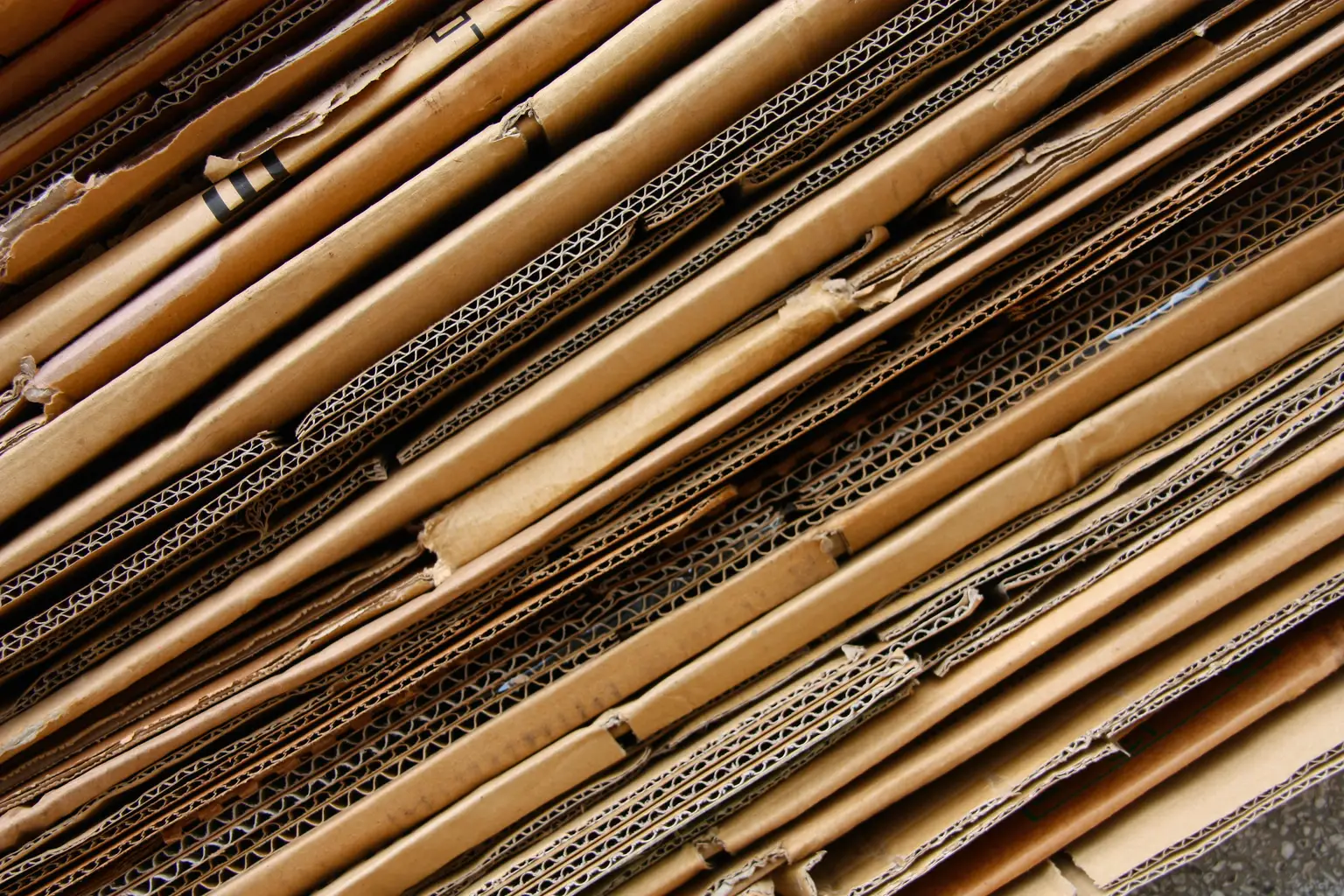
If you run operations for a business that takes deliveries, cardboard is probably the biggest thing in your bins. Kept dry and apart, it has a buyer. Our indicative range is RM0.20–0.35 a kilogram. Crushed into the general bin, it earns nothing and is charged as general waste.
This guide shows what your cartons are worth, how to keep them sellable, and what to ask a collector for.
Cardboard earns money only while it stays dry, clean and apart
A buyer pays for cardboard it can bale and sell on to a paper mill. Three things take that value away.
- Water. Wet cardboard gets downgraded or rejected.
- Food. Greasy or food-soiled boxes lose their value, and a bag of them can spoil a clean load.
- The general bin. Once cardboard is mixed with general waste, nobody can sell it. It is thrown away, not sold.
Drink cartons, the kind milk and juice come in, are a different material from cardboard boxes. Keep them off the cardboard pile, and ask your buyer whether it takes them.
Know which price you are looking at. The range above is the material's market value. That is what a buyer pays for clean, baled cardboard at its gate. What reaches you is a rebate: a share of that value after collection and haulage. So your statement will always show less than a price list. Our recycling rebate guide gives the range for every material.
An e-commerce warehouse kept 73.69% of its waste out of landfill, most of it cardboard
At Signature Market, an e-commerce warehouse, the old hauler offered no recycling. Its packaging went straight to landfill. We set up a plan to send its cartons, plastic and wood to recycling instead.
In 2025 the warehouse kept 68.598 tonnes of its 93.09 tonnes of waste out of landfill. That is 73.69%, and it was mostly carton. The figure is verified in GarGeon Connect.
That is one site's result, not a target for yours. But it shows where the value sits for a business that receives its stock in boxes.
Work out what your cardboard is worth with your own numbers
Weigh your cardboard for one normal week. Then fill in the table. It gives you two figures: what the material is worth, and what you stop paying to throw it away.
| Line | Your figure |
|---|---|
| Cardboard weighed over one normal week (kg) | ____ |
| × 4.3 weeks = kg a month | ____ |
| × RM0.20 to RM0.35 = the material's market value a month (a range, not a quote) | RM____ to RM____ |
| kg a month ÷ 1,000 × RM95.50 = disposal you stop paying on a regular contract | RM____ |
The market value is not your rebate. Your rebate is a share of that value, after collection and haulage.
RM95.50 is the rate our partner collectors are charged, passed on at cost. It is not a gate fee. On a regular collection contract, disposal is charged by weight, from RM95.50 a tonne. Every kilogram you pull out of the general bin is one you stop paying for.
To set this against the rest of your waste bill, use the worksheet in our recycling versus landfill cost guide.
Set up one cardboard point at each site, where the boxes are opened
Boxes are easiest to keep clean where they are emptied. At most sites, that is the loading bay or the stockroom.
- Pick one spot. Put it where stock is unpacked, away from food waste and the general bin.
- Flatten every box. Flat cardboard takes less room and stacks neatly in a cage.
- Keep it under cover. A roof or a lid keeps the rain off. Dry cardboard keeps its value.
Then match pickups to your volume. A buyer will not pay to collect a few boxes now and then. The trip costs more than the load is worth. A steady volume is what makes a site worth the visit.
Not sure how much you produce? A waste audit weighs it for you. Ours is free and takes about a week.
Where Act 672 applies, including Kuala Lumpur and Johor, separation at source is the law. It has been compulsory for commercial, industrial and institutional premises since 2020 (The Star, 8 Dec 2025). Our guide to source separation at scale covers the bins and signs. If your boxes land at a shared mall dock, read our retail and mall waste guide.
Ask for a weighed record of every cardboard pickup
A weighed record does two jobs. It lets you check the rebate against the kilograms that left your site. And it gives you diverted tonnes you can report.
The GRI waste standard asks for three figures, each as a total weight. They are waste generated, waste diverted from disposal and waste directed to disposal. Your cardboard pickups feed the second one.
A GarGeon pickup record carries a photo, a timestamp and the weight. That record changed things for CCL Impex, a vegetable wholesaler. Its previous recycler reported one total a month. With every collection weighed, its recycling rose from 1–2 tonnes a month to 5–6. Its peak monthly rebate was RM2,500.
Ask any collector the same question before you sign. Will every pickup come with its own weight? Our recycling verification guide lists what else to ask.
Cartons from several sites work best on one contract
A chain of shops or outlets has the same problem at every address. Each outlet fills its cages at its own pace. Each may have its own collector, too.
Put them all on one contract. Each outlet's cartons go out on the same pickups as its general waste, kept apart from it. You get one record across every site, and the rebate is shared back to you.
That is how Recycle Solutions works. Licensed partner collectors pick up your separated cardboard. We find and manage vetted recycling buyers for it, and share the rebate with you. Your general waste still goes to landfill, with a record of every pickup. GarGeon owns no lorries and no recycling plant.
When one partner runs collection, recycling and reporting for every site, that is total waste management.
Start with one normal week of cardboard on a scale. Then you will know what your boxes are worth, and what to ask for at every site.
Cover photo: Marek Ślusarczyk (Tupungato), CC BY 3.0, via Wikimedia Commons. Cropped and resized.


